
Guilford County Recent Arrests Portal
The fastest way to find recent Guilford County arrest records is through the Sheriff's Police-to-Citizen recent arrests module. It posts new bookings from county detention facilities and updates as the jail processes new arrivals. The module is public and free. You do not need an account to browse it. Results can include the person's name, the booking date, the charges listed at booking, and bond information when set. Mugshot photos may appear depending on how the module is configured at the time you search.
The inmate roster module works alongside the recent arrests module. The roster shows people currently held at a Guilford County detention facility. If you are looking for someone arrested in the last few days, check both modules. A person may still appear in the recent arrests list after posting bond if the record has not cycled out yet. Jail data changes quickly. An entry can drop off the roster the same day someone is released. For time-sensitive questions about bond, release, or court transport, call the Sheriff's detention center directly rather than relying on the portal alone.
Guilford County operates two detention facilities. Greensboro Detention Center serves the Greensboro area. High Point Detention Center serves the High Point area. A newly arrested person is taken to whichever facility the arresting officer or transport unit assigns. The portal may show the assigned facility in the inmate profile when that field is populated.
- Open the recent arrests module on the Sheriff's Police-to-Citizen site.
- Browse the listed entries or type a name in the search field to narrow results.
- Open a record to see booking date, charges, bond amount, and mugshot if displayed.
- Cross-check with the inmate catalog to confirm current custody status.
- Use the Judicial Branch court-date search to find any scheduled hearing connected to the arrest.
- Call the detention center for bond, release, or transport questions that need same-day answers.
Note: Online arrest records are a starting point, not a release guarantee. They show booking data as of the last system update, not real-time custody status.
Arrest Record vs Criminal Court Record
People often use "arrest record" and "criminal record" as if they mean the same thing. They do not. An arrest record is a law enforcement document showing that a person was taken into custody, booked, and held. A criminal court record is a court file that tracks the case from filing through final disposition. The court file tells the full story of what happened after the arrest. You need both sources to understand any Guilford County criminal matter completely.
| Feature | Arrest Record | Criminal Court Record |
|---|---|---|
| Created by | Law enforcement / jail | Clerk of Superior Court |
| Where to find it | Sheriff's Police-to-Citizen portal | NC eCourts Portal or clerk's office |
| What it shows | Booking date, charges at arrest, bond, mugshot | All filings, hearings, motions, plea, verdict, sentence |
| Shows case outcome? | No | Yes, if the case has been disposed |
| Proof of guilt? | No | Only if a conviction was entered |
| Can be expunged? | Depends on the statute | Depends on the statute |
The Sheriff's portal is where to start for booking data. The Guilford County court records search through the NC eCourts Portal is where you go to see how a case resolved. If you only look at the arrest record, you may miss a dismissal, a not-guilty verdict, or a plea to a lesser charge. For certified copies of court files, request them from the Clerk of Superior Court at the Greensboro courthouse at 201 South Eugene Street or the High Point courthouse at 505 East Green Drive.
Charges vs Convictions in Guilford County Records
A charge is an allegation. It says the State believes a person committed an offense. A conviction is a legal finding of guilt entered by a judge or jury after a plea or trial. Many people with arrest records and criminal charges never receive a conviction. Cases are dismissed, reduced, or resolved by deferred processes. The charge listed on a booking sheet at the time of arrest may not be the final charge that appears in court, and it may not lead to any conviction at all.
| Term | What It Means | Proof of Guilt? |
|---|---|---|
| Arrest | Person taken into custody on probable cause | No |
| Charge / Indictment | Formal accusation filed or returned by grand jury | No |
| Plea of guilty | Defendant admits to the charge in court | Yes |
| Verdict of guilty | Jury or judge finds defendant guilty after trial | Yes |
| Dismissal | Case ended without conviction | No |
| Deferred prosecution | Case paused pending conditions; exact legal effect varies by the specific arrangement | Depends on outcome |
Guilford County criminal cases involving felony offenses move from District Court to Superior Court by indictment or information. Misdemeanor cases are handled in District Court. In both courts, the disposition field in the case record tells you how the case ended. A case showing "disposed" on the portal does not automatically mean conviction. Read the disposition text. Words like "dismissed," "nolle prosequi," "not guilty," or "prayer for judgment continued" each carry specific legal weight. When in doubt, request the actual file through the Clerk of Superior Court.
For background-check purposes, employers and agencies may pull criminal history reports from the North Carolina State Bureau of Investigation or other sources. Those reports draw from statewide criminal-history data, not just the Guilford County jail roster. An arrest that appears on a Sheriff's portal may or may not appear in a formal criminal history, and an expunged record should not appear in either a public court file or a state criminal history after the expunction is fully processed.
Federal Criminal Cases from Guilford County
Some serious criminal matters involving Guilford County defendants are prosecuted in federal court rather than state court. Federal charges arise when conduct involves federal law, crosses state lines, targets federal programs, or is investigated by a federal agency. Drug trafficking networks, firearms offenses, bank fraud, civil rights violations, and organized crime matters are examples of case types that may move to federal court even when the underlying events happened in Guilford County.
Federal criminal records are not in the state eCourts Portal. They are filed with the U.S. District Court for the Middle District of North Carolina, and the public accesses them through PACER at pacer.uscourts.gov. PACER requires a free account, and most documents carry a per-page fee up to a quarterly cap. The U.S. Attorney's Office handles prosecution in these cases but does not provide public criminal-history searches or respond to individual record requests the way a state clerk would.
If you find no result in the Guilford County Sheriff's portal or the NC eCourts Portal, the matter may be in federal court. Federal sentences for prison time are served in Bureau of Prisons facilities. Those inmates are searchable through the BOP inmate locator, not the county roster. Federal bankruptcy cases for Guilford County residents go through the U.S. Bankruptcy Court for the Middle District of North Carolina and are likewise separate from state court files.
Mugshots and Booking Photos in Guilford County
Booking photographs, commonly called mugshots, may appear in the Sheriff's Police-to-Citizen modules when the agency's portal configuration enables them. Whether a mugshot appears depends on how the module is set up at any given time. Not every record shows a photo. The absence of a photo does not mean an arrest did not occur.
A mugshot is taken at booking. It records what the person looked like at the time of arrest. It is not evidence of guilt. Mugshots can cause lasting harm when they circulate permanently online for arrests that were later dismissed or expunged. North Carolina law allows eligible people to petition for expunction of qualifying arrest and charge records under Chapter 15A, Article 5A. After the court grants an expunction, it orders removal of the record from public files. Unofficial websites that scraped the data before the expunction may still hold copies. The court order does not force private sites to delete what they collected before it was issued.
The Sheriff's official portal is the only source to use when researching Guilford County arrest records online. Do not use third-party mugshot sites or people-search aggregators for official or legal purposes. Those sites are not government records and may be outdated, incomplete, or wrong.
Restricted Arrest Records in Guilford County
Not all arrest and criminal records in Guilford County are public. Several categories are restricted by North Carolina law, and knowing which ones apply matters before you rely on a search result that returns nothing.
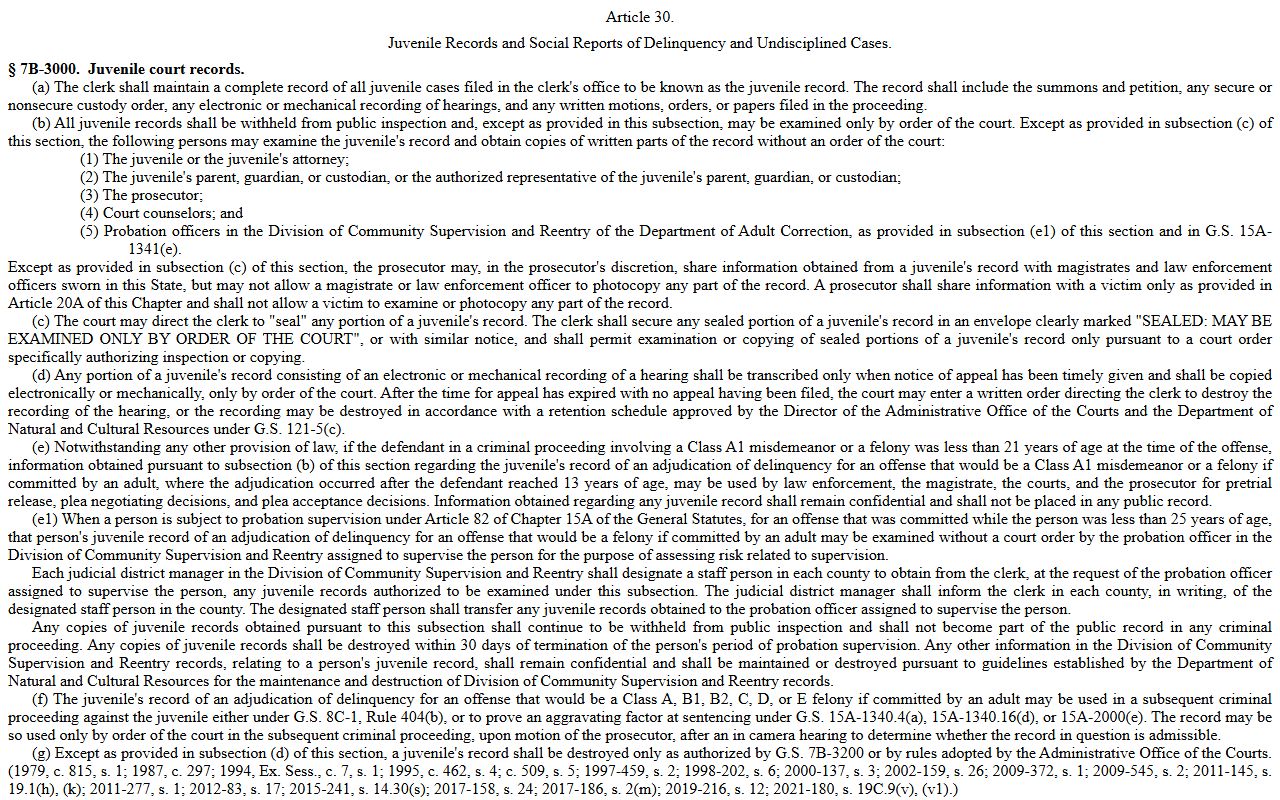
Juvenile records carry the most significant restriction. Delinquency, undisciplined, abuse, neglect, and dependency cases handled under Chapter 7B come with strict confidentiality rules. Public portals should not expose normal juvenile case files. Access is limited to the parties, their attorneys, relevant agencies, and people authorized by statute or a direct court order. If you search the Sheriff's portal and find no record for a minor, the juvenile restriction is the likely reason.
Beyond juvenile cases, other categories of Guilford County records may be restricted or removed:
- Expunged records - removed from public access under Chapter 15A, Article 5A after the court grants a petition.
- Sealed warrants - search warrants and arrest warrants may be sealed during active investigations; public access begins only after return and unsealing.
- Grand jury materials - proceedings are secret; indictments become public only after the grand jury returns them to court.
- Mental health commitment records - confidential under Chapter 122C.
- Victim and protective order details - victim addresses, safety planning notes, and sensitive details about minors in domestic matters may be redacted from any public file.
A missing result may mean the record is restricted, the person used a different name, the arrest was by a city police department whose data is not in the county portal, or the record predates the current system's data range. Contact the Clerk of Superior Court or the Sheriff's Office to clarify when a search returns nothing and you have a specific reason to believe a record exists.
Sealed Records vs Expunged Records
Sealing and expungement are two different legal outcomes. Both limit public access, but they work differently and have different effects on what records remain and who can see them. The distinction matters when someone is asking whether a past arrest or charge still appears in a Guilford County search.
| Feature | Sealed Record | Expunged Record |
|---|---|---|
| How it happens | Court order or automatic by statute for certain case types | Petition filed and granted under Chapter 15A, Article 5A or Chapter 7B |
| Public access | Removed from public view; file may still exist in the court system | Record ordered removed or destroyed from public access entirely |
| Who can still see it | Parties, attorneys, authorized agencies, and people with a court order | Very limited government entities as permitted by the specific statute |
| Effect on disclosure | Cannot be disclosed as a public record without an order | Person may legally deny the record exists in most contexts |
| Unofficial copies | Private sites may still hold the data | Private sites may hold data scraped before the order was entered |
Expunction in North Carolina is statute-specific. Eligibility depends on the charge type, the disposition, the person's prior record, any waiting period the statute requires, and whether all charges in the case were resolved favorably. A person seeking expunction files a petition in Guilford County, serves required agencies when the statute calls for it, and waits for State Bureau of Investigation and Administrative Office of the Courts checks. If the court grants the petition, agencies are ordered to remove the record. Not every arrest or conviction qualifies. Review the exact statute or speak with an attorney before counting on expunction as a remedy.
The District Attorney and Public Defender Roles
Two offices shape what happens to an arrest after it enters the Guilford County court system. The District Attorney prosecutes the case on behalf of the State. The Public Defender represents eligible defendants who cannot afford private counsel. Both operate within Prosecutorial District 24, which covers Guilford County.
The District Attorney for Prosecutorial District 24 decides which charges to pursue after an arrest, whether to offer a plea, when to dismiss a case, and how to proceed at trial. The DA also works with victims and witnesses through the criminal process. The DA does not provide criminal history searches for the public and does not maintain the Guilford County arrest records portal. Those functions belong to the Sheriff's Office and the court system.
The Guilford County Public Defender provides legal representation to eligible indigent defendants after appointment by the court. A defendant who qualifies requests appointed counsel at first appearance or through the clerk using the required affidavit and application. The public defender does not take calls from members of the public seeking criminal history information. The office represents defendants assigned to it by the court. For people who do not qualify for the public defender but need legal help, Legal Aid of North Carolina serves qualifying civil clients, and the NC Bar Association offers attorney referral resources.
Note: The DA represents the State in criminal cases. The public defender represents eligible defendants. Neither office provides public record lookups for arrest histories or criminal backgrounds.
Background Checks and Guilford County Criminal Records
Background checks for employment, housing, or licensing draw from different sources than the Sheriff's booking portal. A consumer background check may pull from court records, state criminal history repositories, or commercial databases. Each source has its own update cycle, coverage range, and accuracy limits. The Sheriff's recent arrests module is a public-safety tool. It is not a background-check product and was not designed for employment screening.
North Carolina criminal history records can be obtained through official state channels. The State Bureau of Investigation maintains criminal history data for law enforcement and authorized purposes. Self-request procedures exist for individuals who want to review their own criminal record; use official state government resources for those requests rather than commercial services.
- Criminal history
- A compiled record from state or federal repositories; separate from a jail roster or court portal.
- Consumer report
- A report assembled by a consumer reporting agency using public records data; governed by the Fair Credit Reporting Act.
- Conviction record
- The court-issued record of a guilty plea or verdict; the most significant data point in a formal background check.
- Arrest record
- Documents a booking; does not indicate guilt and may predate any charges being filed by the DA.
- Expunged record
- A record removed from public access by court order; should not appear in official checks after the agency processes the order.
Arrest records that were expunged should not appear on official background checks after the expunction is granted and processed. If an expunged record still appears on a consumer report, the Fair Credit Reporting Act provides dispute procedures. For the full case history including dispositions, plea outcomes, and sentence details, use Guilford County court records through the NC eCourts Portal or request files from the Clerk of Superior Court. For active jail status, check inmate records. For outstanding warrants, see warrant records.
How a Guilford County Arrest Moves Through Court
An arrest is the beginning, not the end, of the criminal process. From booking through final disposition, a case in Guilford County passes through several stages. Each stage produces records and has its own legal meaning.
The basic flow from arrest to case resolution in North Carolina:
- An officer makes an arrest or a magistrate issues an arrest warrant after reviewing a probable-cause application under Chapter 15A, Article 5.
- The person is transported to a Guilford County detention facility, booked, photographed, and screened for medical and security needs.
- A magistrate or judicial official reviews the case for release conditions; bond is set as secured, unsecured, written promise, or no bond depending on the charge and circumstances.
- Misdemeanor cases are scheduled in District Court; felony cases begin in District Court for initial appearances and probable cause, then move to Superior Court by indictment or information.
- The case resolves by dismissal, plea, deferred process, trial verdict, or other disposition; the court file shows every step in the docket.
- If sentenced to prison, the person moves out of county custody into state custody under the NC Department of Adult Correction, and the NC offender search becomes the right tool for tracking them.
Related records branch off at different points. Warrant records appear before or during an arrest. Booking records appear at detention. Court filings begin when charges are formally submitted. Inmate records track custody during the case. Released inmate data appears when custody ends. For court dockets, the Judicial Branch court-date search shows upcoming hearings. For DWI and serious traffic matters that route through the criminal system, see traffic court records.