
Two Offices, Two Record Types in Guilford County
The most important thing to understand about Guilford County marriage and divorce records is that they are held by separate offices with separate functions. The Register of Deeds and the Clerk of Superior Court both deal with family records, but they do very different things. Mixing them up leads to requests sent to the wrong place and wasted trips to the courthouse.
The Guilford County Register of Deeds is a county office. It issues marriage licenses, records the completed license after the ceremony, and provides certified marriage record copies. It also maintains land records, deeds of trust, and business filings. The Register of Deeds is not a court office.
The Clerk of Superior Court is a state court office. It handles civil and criminal case files, estates, guardianships, and domestic matters. A divorce is a civil court case filed with the Clerk under Chapter 50 of the North Carolina General Statutes. The divorce judgment is a court record, and certified copies come from the Clerk, not the Register of Deeds.
One more distinction matters for name changes. After a marriage, agencies typically want a certified marriage certificate from the Register of Deeds, not a court order. After a divorce, a judgment that includes a name restoration provision can be used to change a name back. Each situation calls for a different document from a different office.
Note: Annulments are court proceedings, not Register of Deeds transactions, so they follow the same path as a divorce through the Clerk of Superior Court.
Guilford County Marriage License Requirements
A marriage license must be obtained from the Guilford County Register of Deeds before the ceremony takes place. North Carolina law under Chapter 51 requires a valid license as a condition of a lawful marriage. The ceremony must be performed by an authorized officiant, and the signed license must be returned for recording after the ceremony. Without that return and recording step, the marriage certificate cannot be issued.
Both applicants need to provide identity and eligibility information. The Register of Deeds uses that information to confirm age, identity, and prior marriage status. If either applicant was previously married, information about how that marriage ended is required. Check the Register of Deeds marriage license page for the current list of acceptable IDs and any updated requirements before visiting or submitting an online pre-application.
North Carolina does not create common-law marriages. A couple living together in North Carolina, without a license and ceremony, does not acquire a valid marriage under state law regardless of how long they have lived together. Valid out-of-state marriages, including common-law marriages formed in states that recognize them, may be recognized under conflict-of-law principles, but that is a legal question rather than a registration question. Same-sex marriages are licensed on equal terms with all other marriages under federal constitutional law.
How to Apply for a Marriage License in Guilford County
The application process is straightforward if you gather what you need before you go. Both applicants typically need to be present, though the Register of Deeds may offer an online pre-application step to get started. Confirm current procedures on the official marriage license page before your visit, since processes can change.
- Visit the Register of Deeds marriage license page and complete any available online pre-application to prepare your information in advance.
- Both applicants appear in person at the Register of Deeds office and present government-issued photo identification. Verify the accepted ID list on the official page before visiting.
- Provide age and date-of-birth information. The Register of Deeds confirms statutory eligibility based on this information.
- Disclose any prior marriages and the date each ended, whether by death of a former spouse or by divorce. Supporting documents may be required.
- Provide a Social Security number or complete the affidavit process if no Social Security number applies. Verify the current requirement with the Register of Deeds.
- Pay the marriage license fee to the Register of Deeds. The current fee is set by the county. Check the official page for the current amount rather than relying on any third-party source.
- Receive the license, have the ceremony performed by an authorized officiant, and ensure the signed license is returned for recording within the time required by law.
- After recording, request a certified copy of the marriage record from the Register of Deeds for name-change, benefit, or legal purposes.
Marriage License Application Field Inventory
The Register of Deeds collects a standard set of information from each applicant. The table below reflects the field categories captured from the official Guilford County marriage license workflow. Some fields are conditional, meaning they apply only when a prior marriage is disclosed or when the Social Security affidavit route applies. Confirm exact field names and any online form requirements directly with the Register of Deeds, since form layouts can be updated.
| Field | Required | Notes / Format |
|---|---|---|
| Applicant 1 legal name | Yes | Full legal name as shown on government-issued ID. |
| Applicant 2 legal name | Yes | Full legal name as shown on government-issued ID. |
| Date of birth / age | Yes | Used to confirm statutory eligibility for each applicant. |
| Government-issued identification | Yes | In-person presentation required. Verify current accepted ID list on the official page. |
| Social Security number or affidavit | Conditional | SSN is commonly required; an affidavit may substitute when no SSN has been issued. Verify current wording with the Register of Deeds. |
| Prior marriage information | Conditional | Divorce date or death date of former spouse required if previously married. |
| Contact information | Yes | Used by the Register of Deeds; typically includes phone or email. |
| Submit / Continue | Yes | Completes the pre-application or in-person workflow step. |
Searching Guilford County Marriage Records
After a license is returned and recorded, the Register of Deeds maintains the marriage record and issues certified copies. The Register of Deeds operates an online search portal at search.guilforddeeds.com, which covers recorded documents including marriage records. You can search by name, document type, or date range. The portal is useful for confirming that a record exists and identifying an instrument number before requesting a certified copy.
A certified copy of a marriage record carries an official seal and is the document that government agencies, employers, and courts accept as proof of marriage. The Register of Deeds issues these copies for a fee. Confirm the current fee on the official vital records page before visiting or mailing a request. Uncertified printed copies from the online portal are useful for personal reference but are generally not accepted as official proof.
The North Carolina Vital Records Office also maintains statewide records. For marriages recorded at the state level, the state office is an alternative source for certified copies. The state office works from records submitted by county register of deeds offices, so county records and state records should ultimately match for the same event.
North Carolina Marriage Law and Chapter 51
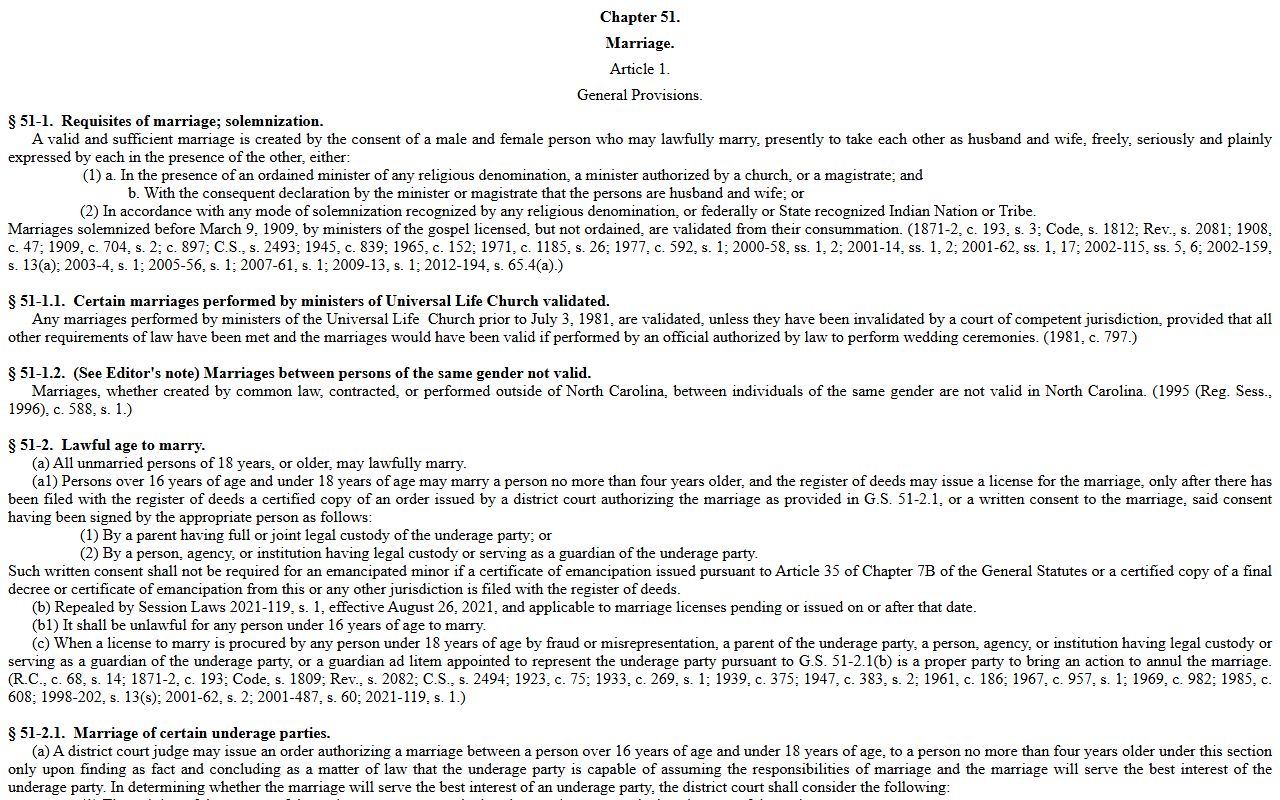
North Carolina marriage law is found in Chapter 51 of the General Statutes. The chapter covers who can marry, who can perform a ceremony, what the license must contain, how it must be returned, and what happens if the rules are not followed. The Register of Deeds works within this framework when issuing and recording licenses in Guilford County.
Chapter 51 identifies authorized officiants as magistrates, ordained ministers of any religion, and other persons authorized by law to perform marriage ceremonies. The license must be issued by the register of deeds in the county where at least one applicant resides, or in the county where the ceremony will take place if neither applicant is a North Carolina resident. Guilford County residents apply at the Guilford County Register of Deeds regardless of where the ceremony occurs within the state.
The signed and completed license must be returned for recording within the time required by statute. The register of deeds records it and issues certified copies on request. A ceremony performed without a valid license is not a lawful marriage under Chapter 51. Prior marriages must be ended by death of the former spouse or by a final divorce decree before a new license can issue.
Guilford County Divorce Records and How to Find Them
Divorce in North Carolina is a civil court case filed under Chapter 50 of the General Statutes. The case is filed with the Clerk of Superior Court in the county where the plaintiff or defendant resides. In Guilford County, that means filing at the courthouse located at 201 South Eugene Street in Greensboro. The court handles the file, schedules any required hearings, and issues the final judgment.
An absolute divorce under Chapter 50 generally requires that one party has been a North Carolina resident for at least six months and that the parties have lived separate and apart for at least one year. The separation must be continuous and intended to be permanent. These are statutory requirements, not just practical ones, so the complaint and any supporting affidavit must address them directly.
Once a divorce is filed, the case appears in the North Carolina eCourts Portal as a domestic civil matter. You can search by party name or case number. The portal shows docket entries, hearing dates, and case status for public-access portions of the file. Some content in domestic cases, especially portions involving children, financial accounts, or other sensitive details, may be restricted or not visible in the public view. The Clerk of Superior Court is the authoritative source for complete case information and certified copies of filed documents.
A divorce does not automatically resolve every related issue. Equitable distribution of property, alimony, child custody, and child support are separate claims that must be raised and handled within the case or in separate proceedings. Failing to raise equitable distribution before the absolute divorce is granted may bar that claim under North Carolina law. Parties facing these issues should review them carefully with an attorney before the divorce is finalized.
Note: Domestic court files may include sensitive financial and child-related information. Restricted portions are not accessible through the public portal and require a court order or authorized request to the Clerk.
Filing for Divorce in Guilford County
A divorce complaint is a civil pleading that starts a court case. The steps below outline the general workflow for an absolute divorce filed in Guilford County. Individual circumstances vary, and an attorney can advise on any steps that differ based on the specifics of a case.
- Confirm that at least one party has been a North Carolina resident for six months or more and that the parties have lived separate and apart for at least one year.
- Prepare the complaint for absolute divorce, a civil summons, and the domestic civil action cover sheet. A fee waiver application may be filed separately if the filing party qualifies as indigent, but approval is not automatic.
- File the complaint with the Clerk of Superior Court at the Guilford County Courthouse, 201 South Eugene Street, Greensboro, NC 27401. Pay any required filing fee or submit the fee waiver at the same time.
- Serve the opposing party according to the North Carolina Rules of Civil Procedure. Service can be by sheriff, by certified mail with return receipt, or by another approved method. Proof of service must be filed with the Clerk.
- Calendar a hearing or proceed under local domestic rules. Guilford County District Court handles domestic matters. A hearing before a judge or magistrate may be required to enter the divorce.
- Attend any scheduled hearing and present the required evidence of residency, separation, and identity.
- After the judge signs the judgment, request a certified copy from the Clerk of Superior Court for use in remarriage, name restoration, immigration, benefits, or other legal purposes.
Guilford County Marriage and Divorce Fee Schedule
Fees in Guilford County for marriage and divorce matters are set by the county and by the state court system. The table below lists each item and the official source to confirm the current amount. No dollar amounts are published here because fees change and the official sources are the only reliable reference. Always check the listed source before submitting payment.
| Item | Official Source to Verify Current Fee |
|---|---|
| Marriage license fee | Guilford County Register of Deeds marriage license page |
| Certified copy of marriage record | Guilford County Register of Deeds vital records page |
| Divorce / domestic civil filing fee | NC Administrative Office of Courts fee schedule publication |
| Certified copy of divorce judgment or court record | NC Administrative Office of Courts fee schedule publication |
| Indigent / fee waiver | File application with the Clerk at time of filing. Approval is not automatic. |
The Register of Deeds collects the marriage license fee and the fee for certified marriage copies. The Clerk of Superior Court collects civil filing fees and the fee for certified copies of court records. These are separate offices with separate fee schedules. Paying one does not cover anything at the other.
Certified Copies of Guilford County Marriage and Divorce Records
A certified copy is the legally recognized form of a marriage or divorce record. Banks, courts, the Social Security Administration, the Department of Motor Vehicles, immigration agencies, and employers routinely ask for certified copies rather than plain printouts. Each copy carries an official seal or stamp and the signature of the issuing official, which is what makes it acceptable.
For a certified marriage record, the request goes to the Guilford County Register of Deeds. You can request in person or check the Register of Deeds page for any mail or online request options. Bring or provide the full names of both parties and the approximate date of the marriage to help locate the record quickly.
For a certified copy of a divorce judgment, the request goes to the Clerk of Superior Court at the Guilford County Courthouse. Have the case number if possible. The Clerk also has access to the eCourts system for searching filed cases. The North Carolina Judicial Branch page on obtaining court records covers the general process for requesting certified copies of court files.
Both offices charge fees per copy. Verify the current amounts before your visit. Processing time is generally quick for in-person requests when the record is located. Mail requests may take longer depending on the workload at each office.
Restricted Material in Divorce and Domestic Files
Domestic court cases in Guilford County can contain sensitive information that is not open to the general public. While the core docket, the names of parties, and the final judgment are typically available as court records, some portions of the file are restricted. Understanding what is and is not public helps you plan a records request correctly.
Child custody orders, parenting plans, and related filings in a domestic case are court records, but the content involving the specific child may be handled with care. Financial records submitted as exhibits during equitable distribution proceedings can include account numbers and other protected data. The clerk redacts or restricts this material under court rules and applicable statutes. What you see in the eCourts Portal may be less than what is in the full physical file.
- Social Security numbers, account numbers, and financial identifiers are redacted from public filings under North Carolina court rules.
- Minor children's names and identifying information in custody filings may be limited in public access.
- Medical or mental health information submitted as evidence may be restricted.
- Protective orders and domestic violence proceedings may have content that is not fully public.
- Sealed filings require a court order to access. A party to the case or their attorney can file a motion to unseal if there is a legal basis.
If you are a party to the case, you have rights to your own file through the Clerk of Superior Court. If you are a third party, you are limited to what is publicly accessible. The Clerk can tell you whether a specific document is public or restricted when you make a request in person.