
How to Search Guilford County Traffic Court Records
Traffic cases run through the state court system. The fastest tool is the citation lookup, which finds a case by citation number and may allow payment. For hearings, the court date search shows upcoming sessions. The eCourts Portal covers broader case records in eCourts counties.
The citation number on your ticket is the best search key. Names can be misspelled or shared, so a number gives the cleanest match. The fields below show how the citation lookup is set up.
| Field Label | Type | Required | Notes / Format |
|---|---|---|---|
| Citation number | Text | Conditional | Best search method; copy it exactly from the ticket |
| Name | Text | Conditional | Used if the citation number is unknown |
| County | Dropdown | No | Select Guilford where available |
| Search | Button | Yes | Runs the lookup |
| Pay / Continue | Button | Conditional | Appears only when online payment is allowed |
Which Courts Handle Traffic Cases in Guilford County
Traffic and infraction matters are handled mainly through District Court and the citation process. Guilford County holds these cases at the Greensboro and High Point courthouses. The Clerk of Superior Court keeps the files for both. Your notice or the court date search tells you which courthouse to use.
Most minor traffic matters are infractions, not crimes. They are still court cases. A serious driving charge can move to the criminal side and may reach Superior Court. A failure to appear can add fees, trigger license action, and lead to an order for arrest in criminal traffic matters, so a missed date should be fixed fast. For the court structure, see the page on Guilford County Superior Court, and for clerk contact, see the Clerk of Superior Court.
Types of Traffic Cases on Record
Traffic records cover a wide range. Some are payable tickets. Others require a court appearance. The charge decides how the case is handled and what shows in the record.
- Speeding and infractions - common payable citations like speed, stop sign, or seat belt.
- Moving violations - charges that may affect a license or insurance.
- Driving while license revoked - a charge that often needs a court appearance.
- No insurance or registration - cases tied to vehicle and coverage rules.
- Criminal traffic - impaired driving, reckless driving, and hit-and-run, treated as crimes.
Note: impaired driving, reckless driving, driving while license revoked, and accident-related charges are not simple tickets and can carry serious consequences.
What Guilford County Traffic Court Records Show
A traffic record holds the facts of the citation and the case. It names the driver, the charge, the court date, and the outcome. It does not show a full driving history, which the state keeps separately.
| Field | What It Shows |
|---|---|
| Citation Number | The unique number assigned to the ticket |
| Defendant Name | The cited driver, sometimes with a partial address |
| Charge / Statute | The offense and the law section cited |
| Date and County | When and where the citation was issued |
| Court Date / Courtroom | The session set for the case |
| Waivable Status | Whether the offense can be paid without a court appearance |
| Fine and Court Costs | The fine and the separate court costs, if set |
| Disposition | The final outcome of the citation |
Searching by Citation Number vs by Name
Two search keys work. Each has trade-offs. The citation number is precise. A name search is broader and can return the wrong person.
Use the citation number when you have the ticket in hand. Copy it exactly, including letters and leading zeros. Use a name search only when the number is lost, and add the county and a date to narrow the result. Court costs are separate from the fine, so a record may list both. For full case history beyond traffic, see the page on Guilford County court records.
Paying or Contesting a Guilford County Traffic Ticket
You usually have two paths. You can pay a payable citation, or you can contest it in court. Paying is not always the simple choice, because it can be treated as resolving the charge and may carry license or insurance effects.
- Look up the citation by number to see the charge and court date.
- Check whether the offense is payable online or requires an appearance.
- If payable, weigh the license and insurance effects before you pay.
- If contesting, appear on the court date or speak with an attorney about options.
- For a missed date, address the failure to appear and any license consequence quickly.
- Confirm the final disposition in the record after the case ends.
A reduction request is a legal strategy, and court staff cannot advise whether to seek one. A Prayer for Judgment Continued is a North Carolina outcome sometimes discussed in traffic cases, but its eligibility and effects are legal questions for an attorney.
Public Access Laws for Traffic Court Records
Traffic court records are generally open, like other court files. They sit within the state court system and follow the same access rules. Some details are limited, such as juvenile matters or protected personal data. Certified copies of a disposition come from the Clerk of Superior Court.
Crash reports are not traffic court records. They are law-enforcement and state records held by other agencies. Camera or photo-enforcement civil penalties, if any city uses them, are also separate from state court records. For the broader open-records framework, see the page on Guilford County public records.
Court Traffic Records vs State Driver Records
These are two different files kept by two different agencies. The court traffic record lives with the court and clerk. The driver record lives with the North Carolina DMV. Mixing them up leads to the wrong office.
| Item | Court Traffic Record | State Driver Record |
|---|---|---|
| Custodian | Clerk and Judicial Branch | North Carolina DMV |
| Shows | Citation, charge, court date, disposition, costs | License status, reported convictions, points, suspensions |
| How to Search | Citation lookup, eCourts, court date search | DMV driver record request |
| Certified Copy | Clerk for the court disposition | DMV for the driver history |
| Impaired Driving | Criminal court case | Also creates license consequences |
A single ticket can create both a court case and a driver-record entry. To fix an error, you go to the right custodian for that file. The court can change a disposition, but only the DMV can correct a license history, so check both when a case ends.
CDL and Commercial Driver Records
Commercial drivers face stricter rules. A traffic conviction can carry special federal and state reporting effects for a CDL holder. Paying a citation without checking those effects can be a costly mistake.
Out-of-state drivers are not off the hook either. A North Carolina citation can still reach a home-state license through interstate reporting. CDL holders and out-of-state drivers should get legal advice before they simply pay. For criminal driving charges, see the page on Guilford County arrest records.
DWI and DUI Cases
Impaired driving is a criminal matter in North Carolina, not a payable ticket. A DWI case follows the criminal process, with court appearances and possible jail, fines, and license action. It is governed by the state's criminal process statutes.
Because a DWI is criminal, it is covered in more depth on the page for Guilford County arrest records. Do not treat it as a simple traffic citation.
Deferred Options and Driving Courses
North Carolina has outcomes that are not a simple guilty or not guilty. A Prayer for Judgment Continued can come up in traffic cases, but its limits and its license and insurance effects are legal questions. A driver improvement or defensive driving option may apply in some settings, yet it is not a guaranteed path to dismissal.
None of these are automatic. Eligibility depends on the charge, the record, and the court. An attorney can explain whether any of them fits your case. Court staff cannot give that advice.
Sealing or Expunging Traffic Records
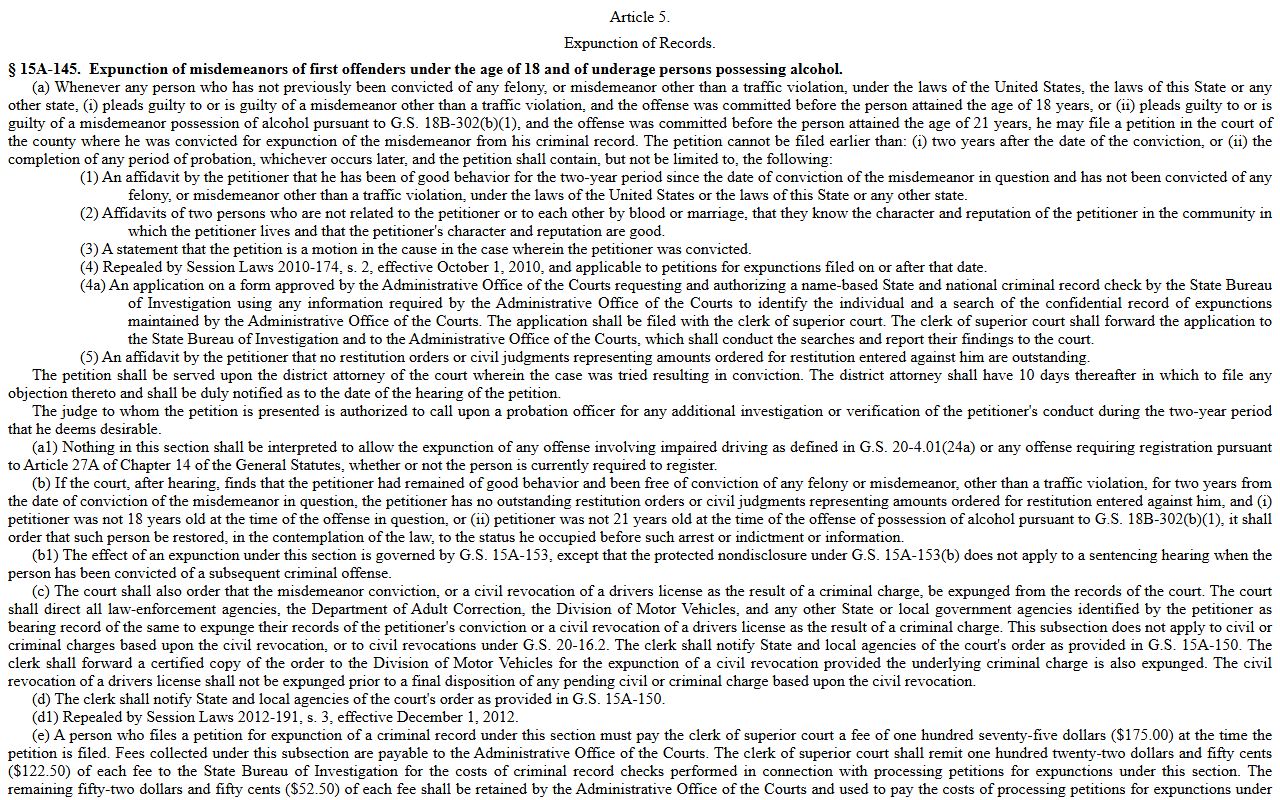
Most minor infractions stay on the court record, though dismissed charges may be eligible for expunction under state law. Expunction is statute-specific and depends on the charge, the disposition, and prior record. It is not a blanket right.
A criminal traffic charge that is dismissed or resolved in the driver's favor may qualify under the state's expunction statutes, but eligibility needs a careful review. The page on Guilford County court records covers how sealed and expunged records work. An attorney or the clerk can point you to the right petition.
Fees for Traffic Record Copies
Court costs and fines are set by the state, and a certified copy carries its own fee. Because amounts change, the table points to the official source rather than a figure that may be out of date.
| Item | Official Source |
|---|---|
| Fine and court costs | Set by statute and the AOC fee schedule |
| Certified disposition copy | Clerk of Superior Court |
| Online citation payment | Judicial Branch citation system, when payable |
| Driver record copy | North Carolina DMV |
Common questions about tickets and court dates are answered on the FAQ page.