
The North Carolina Public Records Act
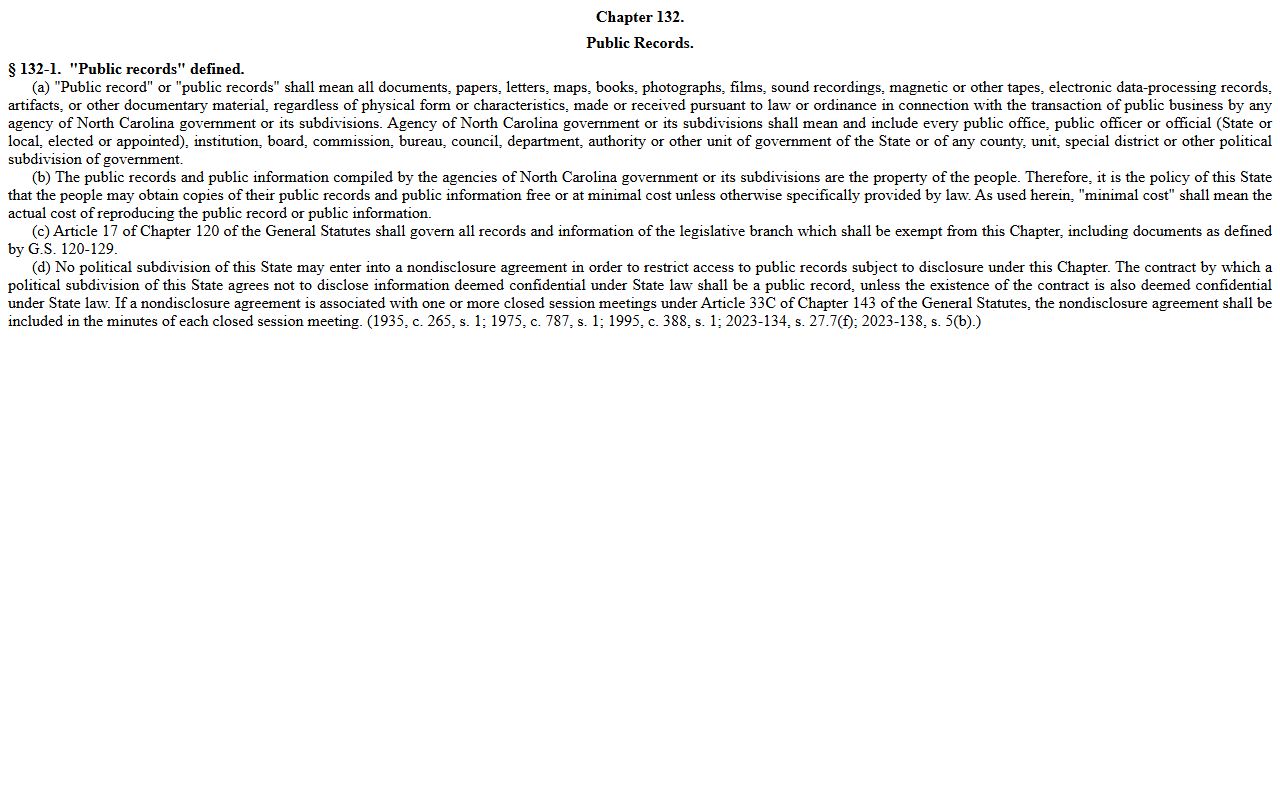
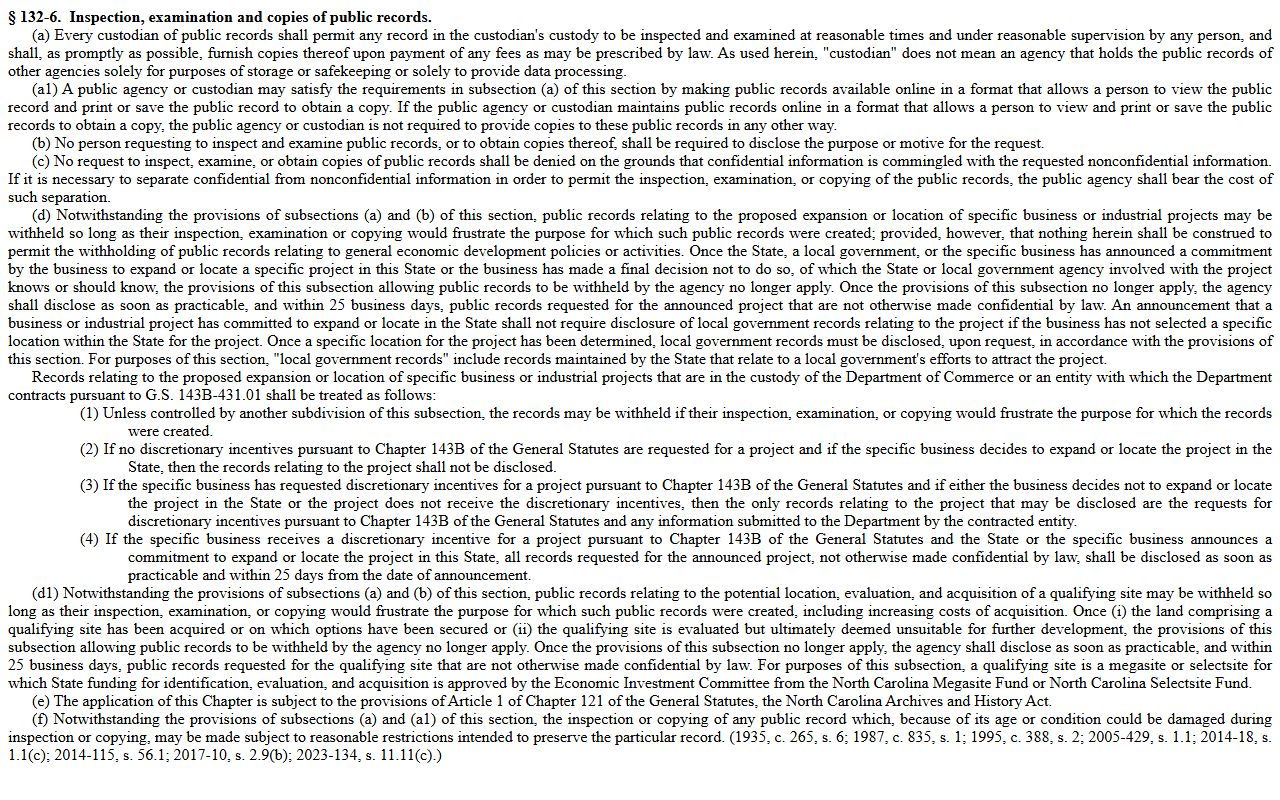
North Carolina gives broad public access to government records through Chapter 132 of the General Statutes. The core definition in G.S. 132-1 is wide: public records include most materials made or received in the course of public business by any state or local agency. That covers paper documents, electronic files, photographs, data, and other formats held by county offices, the sheriff, and county boards. The right to inspect and copy those records comes from G.S. 132-6, which directs custodians to allow inspection at reasonable times and produce copies when requested.
Chapter 132 is a broad starting point, but it does not override every other law. A record can be a public record in general and still be confidential because a more specific statute says so. Juvenile case files are restricted under Chapter 7B. Adoption records are sealed under G.S. 48-9-102. Personnel files have their own access limits. Law-enforcement investigative material may be withheld during active investigations. When in doubt, ask the custodian for the specific legal basis of any restriction or denial.
Court records sit in a different legal space. Guilford County court records are state-court records maintained by the Clerk of Superior Court under the Judicial Branch. They are governed by Chapter 7A, specific confidentiality statutes, and court rules, not just by Chapter 132. That means access to court files goes through the clerk and the rules the courts apply, while county-agency records like budgets, meeting minutes, and administrative documents are where Chapter 132 applies most directly.
Public does not automatically mean posted online. Many public records require in-person inspection, a written request, archive retrieval, or redaction time before release. Online portals often show indexes and summary data while withholding specific documents. A certified copy is different from a portal printout; certified copies carry an official seal and are required for legal proceedings, court appearances, and many government applications.
What Counts as a Guilford County Public Record
Understanding exactly what qualifies as a public record under North Carolina law shapes how you frame a request. The statutory definition at G.S. 132-1 is intentionally broad. It reaches correspondence, financial records, contracts, reports, maps, photographs, data compilations, and any other material made or received by a public agency in the transaction of official business.
Key distinctions matter in practice. A police report is a law-enforcement agency record, not a court case file. A deed is a recorded instrument held by the Register of Deeds, not the court clerk. A court judgment is a court record from the Clerk of Superior Court, not a county administrative record. Tax records live with the county tax assessor. Meeting minutes and county budgets are county government records. Each category may have its own access rules, its own fee schedule, and its own custodian office.
Redaction and sealing are two different tools. Redaction removes specific pieces of protected information from an otherwise public record, such as removing a Social Security number from a filed document before releasing it. Sealing restricts an entire record or file from public view, usually by court order or specific statute. Expunction goes further: it orders agencies to remove eligible criminal records from public access entirely. You can have a public record that contains redacted items, and you can have a sealed record within an otherwise public case file. Each layer has a separate legal basis and a separate process for challenging it.
Note: Asking for the legal basis of a denial is always your first step before considering any further review or court action.
Court Records vs County Agency Records
Many people treat these as the same thing. They are not. The distinction matters because each type goes to a different office with a different process.
Court records are Judicial Branch records. They include case files, judgments, orders, criminal dispositions, civil filings, divorce case records, estate and guardianship proceedings, and docket entries. The Clerk of Superior Court maintains these files. Access goes through the clerk's office at the Guilford County Courthouse or through the North Carolina eCourts Portal for records the portal makes available. Court records follow the rules set by Chapter 7A, specific confidentiality statutes, and court administrative orders. The county commissioners do not control these records. The Judicial Branch does.
County agency records are a different matter. These are records created by Guilford County government offices acting in their official capacity. County budgets, commissioner meeting minutes, zoning records, public health administrative files, and Sheriff's Office administrative records fall under Chapter 132. Requests for these records go to the relevant county department, not to the court clerk. The Guilford County government website links to departments that hold county administrative records.
Some records touch both worlds. A civil judgment can be a court record and also appear in a Register of Deeds filing when a creditor records a lien against property. A protective order can be both a court case file and a law-enforcement record used by the sheriff. Know which aspect you need before sending a request, because the clerk and the sheriff keep different copies for different purposes.
Register of Deeds Public Records
The Guilford County Register of Deeds is one of the most-used public records offices in the county. It is separate from the court system. The Register holds recorded documents, not court case files.
Records the Register of Deeds maintains include these categories:
- Deeds and deeds of trust -- recorded real estate conveyances and mortgage instruments for property in Guilford County.
- Plats and maps -- recorded subdivision plats and survey maps.
- Marriage licenses and certificates -- marriage licenses issued and returned after ceremony, searchable through the marriage and divorce records page.
- Assumed business names -- filings for businesses operating under a trade name in the county.
- Birth and death records -- vital records within the Register's authority, subject to eligibility rules for certified copies.
- Military discharge records -- DD-214 and similar documents, with special access restrictions that protect veteran privacy.
The Register of Deeds maintains a public online search at search.guilforddeeds.com. You can search by name, document type, date range, book and page, or instrument number. The portal returns index results; certified copies require a request and payment through the Register of Deeds office. Always confirm current fee and copy-request procedures on the official Register of Deeds page before submitting a request.
Marriage records from the Register of Deeds are different from divorce case files. Divorce is a court case filed with and decided by the Clerk of Superior Court under Chapter 50. Divorce judgments are court records. A marriage license is a Register of Deeds record. These two documents come from two different offices, and mixing up the request can cause delays.
Inspection and Examination of Guilford Records
The right to inspect public records is set out in G.S. 132-6. Custodians must allow inspection at reasonable times. You generally do not need to give a reason for wanting to view a public record. You do not need to identify yourself for most Chapter 132 requests. The record is public because it was made in connection with public business, not because you have a personal stake in it.
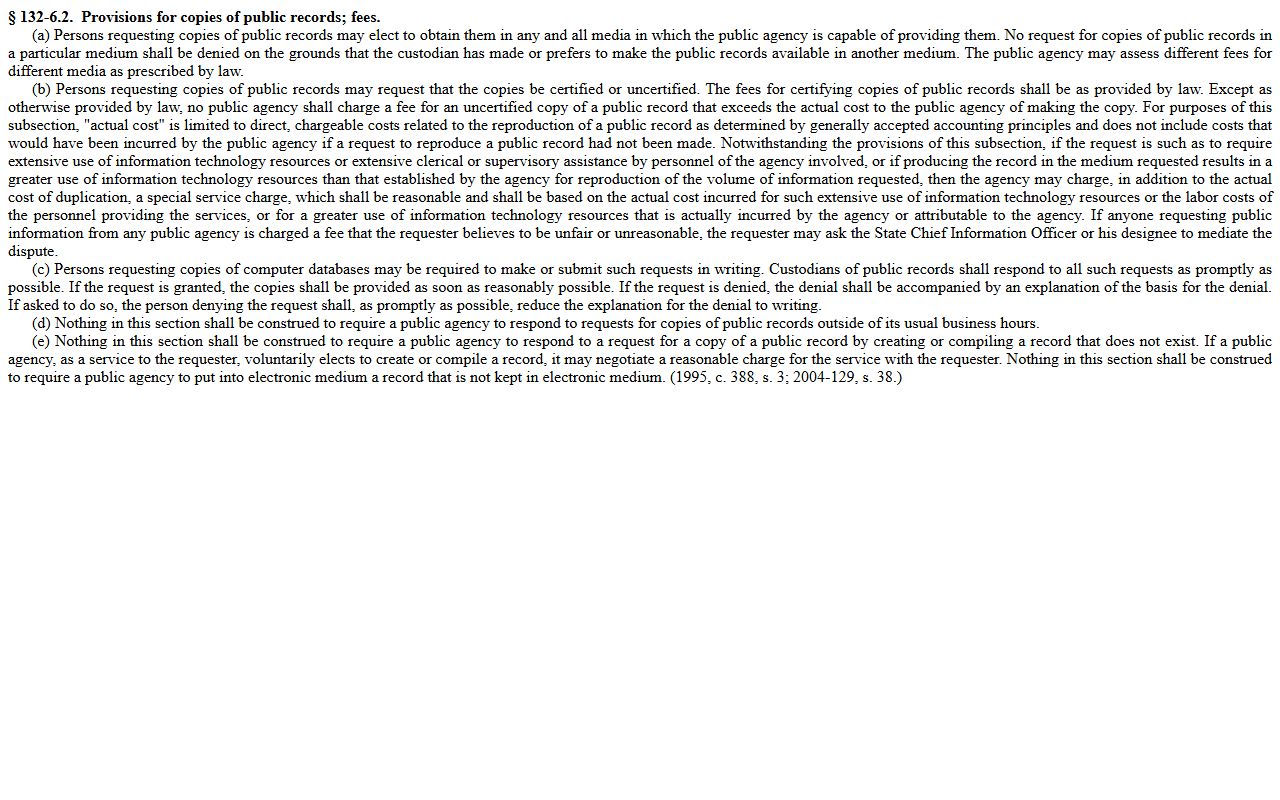
Inspection means looking at the record. Copying costs extra. Agencies must allow you to inspect a public record without charging you just for access; the fee applies when you ask for copies. For court records, the Judicial Branch fee schedule controls copy costs. For county agency records, the fee rules under G.S. 132-6.2 apply. Large or complex requests can take time because staff must review each page for protected information, redact what is required by law, and prepare the release.
Some records require advance notice or a written request, not because the agency can deny access, but because pulling archived files, preparing redactions, or assembling multi-document responses takes time. The law does not require instant production of everything in an agency's files. It does require timely response and good-faith processing. If a record is not immediately available, the custodian should tell you when it will be ready.
For court records at the Guilford County Courthouse, bring the case number, the party names, and a photo ID. The obtaining court records help page from the Judicial Branch explains the process for requesting certified copies from the clerk. The Greensboro courthouse is at 201 South Eugene Street, Greensboro, NC 27401. Guilford County also has a court facility at 505 East Green Drive, High Point, NC 27260.
Public Records Fees in Guilford County
Fees for copies of public records are governed by G.S. 132-6.2. The law allows agencies to charge for the actual cost of copying or for a rate set by statute or rule, but agencies cannot charge simply for locating or reviewing records. The fee is tied to the copy, not to the search itself.
Different offices use different fee sources. The table below lists the main fee categories and where to find current amounts. No dollar figures appear here because official rates change and should be confirmed before you request copies.
| Item | Official Source |
|---|---|
| Court case copies and certified copies | AOC Fee Schedule (Judicial Branch) |
| Civil filings, estates, special proceedings | AOC Fee Schedule |
| Register of Deeds recorded document copies | Guilford County Register of Deeds page |
| Register of Deeds vital record certified copies | Register of Deeds Vital Records page |
| Marriage license fee | Guilford County marriage license page |
| County administrative record copies | Relevant county department per G.S. 132-6.2 |
| Sheriff administrative records | Guilford County Sheriff's Office |
Certified copies are more expensive than plain copies. A certified copy carries a seal and signature from the custodian, which makes it acceptable for legal filings, immigration applications, and government agency submissions. Plain copies are fine for personal reference. If an agency, court, or employer asks for a certified copy, a portal printout will not substitute.
How to File a Public Records Request
North Carolina does not require a specific written form for Chapter 132 requests to county agencies. Many agencies accept verbal requests, but a written request creates a clear record of what you asked for and when. The steps below apply to county agency records. Court record requests go through the Clerk of Superior Court and follow Judicial Branch procedures.
- Identify the record and the custodian. Know which office holds what you need. Court records go to the Clerk of Superior Court. Deeds and marriage records go to the Register of Deeds. Sheriff administrative records go to the Sheriff's Office. County meeting minutes and budgets go to the relevant county department or county manager's office.
- Describe the record as precisely as possible. Include the name, date range, case number, document title, or other identifying detail. Vague requests take longer because staff must interpret what you want. The more specific you are, the faster the response.
- State how you want to receive the record. Specify whether you want to inspect it in person, receive a plain copy, or need a certified copy. If you want electronic delivery, say so. Certified copies take more time and cost more.
- Submit the request to the correct office. Use email, mail, or in-person delivery as the agency accepts. The Guilford County government website lists department contact information.
- Follow up if you do not hear back promptly. G.S. 132-6 requires records to be produced as soon as practicable. If the agency does not respond, ask for a status update in writing and keep a record of your follow-up.
- Ask for the legal basis of any denial. If the agency says a record is exempt, it should give you the specific statute or rule that supports the denial. A general refusal without legal authority is not a valid response under Chapter 132.
- Seek review if denied without legal basis. Under Chapter 132, a person who believes access was wrongly denied may seek review by the agency head, contact the state for guidance, or bring a civil action. An attorney can help if the denial appears improper.
For court records specifically, the Judicial Branch's obtaining court records page explains the process for certified copy requests and in-person access. Court records follow Judicial Branch rules, not the standard county agency Chapter 132 process.
Public Records Request Form Fields
While North Carolina does not require a statewide form for Chapter 132 requests, many county agencies use a standard form to collect the information they need to process your request quickly. The fields below reflect what most agencies will ask for. Having this information ready makes the process faster.
| Field | What to Provide |
|---|---|
| Requester name | Your full legal name. North Carolina does not require you to identify yourself for most public records requests, but many agencies include this field for contact purposes. |
| Contact information | Mailing address, email, or phone where the agency can reach you with records or a status update. |
| Record description | The name of the document, type of record, case number, date range, or other details that identify what you are requesting. |
| Custodian or department | Which office you believe holds the record. Helps route the request to the right staff. |
| Format requested | Paper copy, electronic copy, certified copy, or inspection only. Certified copies cost more and take longer to prepare. |
| Delivery method | In-person pickup, mail, or electronic delivery where offered by the agency. |
| Date of request | The date you are submitting the request. Helps establish the timeline for the agency's response obligation. |
Court record requests have additional requirements because the Clerk of Superior Court follows Judicial Branch procedures. Provide the case number or case name and type, the specific document you need, your contact information, and your preferred pickup or delivery method. The clerk can tell you the current fee before you pay. For probate and estate records, see the probate records page for more on estate filings in Guilford County.
Note: A printed portal page or screenshot is not a certified copy and will not satisfy agencies, lenders, or courts that require official certification from the custodian.
Guilford County Sheriff Public Records
The Guilford County Sheriff's Office holds several types of records that are open to the public. These are not the same as court case records, even when they relate to the same arrest or event.
Sheriff records that are generally public under Chapter 132, subject to law-enforcement exemptions, include jail custody and booking information, recent arrest data, wanted persons postings, and certain administrative records. The Sheriff's public Police-to-Citizen portal exposes inmate search, recent arrests, and wanted persons data at separate web addresses. Jail roster data is a real-time snapshot and can lag behind actual custody changes, so calling the detention center is more reliable for time-sensitive questions.
Law-enforcement investigative material carries a broader exemption under Chapter 132 than ordinary agency records. An open investigation can justify withholding records that would otherwise be public. Once a case is resolved or transferred, more material may become available. Arrest reports, incident reports, and body-camera footage may each follow a different access path depending on investigation status and the specific statute that applies.
Detention center policies, administrative procedures, and staff records are separate from inmate booking records. The detention centers page covers jail facility information for both the Greensboro and High Point facilities. For arrest records or inmate records, the dedicated pages on this site walk through the Sheriff's public search tools in more detail.
Confidential Guilford County Records
Not every Guilford County government record is open. Several categories receive specific statutory protection, and those protections override the general openness of Chapter 132. Knowing which categories apply helps you understand why a request may be denied and what your next steps are.
The most commonly encountered restrictions in court and county records include these:
- Juvenile records -- delinquency, abuse, neglect, dependency, and termination cases are confidential under Chapter 7B, Article 30. Access is limited to parties, attorneys, and court-authorized persons.
- Adoption records -- sealed under G.S. 48-9-102. Access requires a specific statutory process or court order.
- Expunged criminal records -- removed from public access under Chapter 15A, Article 5A. Expunction requires a petition, court review, and a signed order directing agencies to remove the record.
- Mental health records -- commitment and treatment records are confidential under Chapter 122C, Article 5.
- Sealed warrants -- search warrants and arrest warrants can be sealed during active investigations. Public access often begins only after execution and return to the court.
For sealed court records, gaining access usually requires filing a motion and getting a judge's order. The clerk cannot unilaterally open a sealed file. If you believe sealing was improper, an attorney can help you draft a motion to unseal and argue it before the assigned judge. Expunged records are different from sealed records: expunction orders the agency to destroy or remove the record from public access, not just restrict viewing. An expunction does not automatically reach unofficial or private websites, which may retain copies and need separate notice or dispute requests to remove them.
Victim information in domestic violence, sexual assault, and child abuse cases receives additional protection beyond standard redaction. Protected addresses, victim-identifying details, and safety-planning material are withheld from routine public access whether or not the record is formally sealed.
Response Timelines and Denials
North Carolina law requires public records to be produced as soon as practicable. The statute does not set a fixed number of days because different requests carry different complexity. A simple one-page document ready in a file can be produced quickly. Thousands of pages requiring redaction review take longer. If you ask for a record and the agency does not respond promptly, ask for a status update and an estimated completion date.
Agencies can lawfully withhold records that are confidential, sealed, or exempt under statute. What they cannot do is withhold records without a legal basis or delay production unreasonably. If you receive a denial, the first step is to ask for the specific statute, rule, or court order that supports it. A vague "this is not available" is not a lawful denial under Chapter 132.
For county-agency records, a person who believes access was wrongly denied may seek review by the agency head, contact the North Carolina Attorney General's office for guidance, or file a civil action in Superior Court. For court records, the process is different. The clerk and the presiding judge control access to court files under Judicial Branch rules. A motion to unseal or a petition to access restricted records in the court system goes before a judge, not a county board or administrative office.
The Guilford County Superior Court is the primary trial court for civil actions challenging denied public records requests. Legal help is available through Legal Aid of North Carolina for qualifying individuals and through the NC Bar Association lawyer referral for private attorney contacts. The FAQ page also addresses common questions about court record access and certified copies in Guilford County.